
Andiani Tablero
Audit and hardening of the real-time internal operations platform of a ~260-property vacation rental manager. Database consumption −75%.
- Role
- Lead Developer
- Client
- Andiani Travel
- Year
- 2026
- Type
- DASHBOARD
- Stack
- React · TypeScript · Firebase · Cloud Functions · Tailwind CSS · GitHub Actions
- Key figures
- −75%Database consumption~260Properties150+Cloud Functions
Context
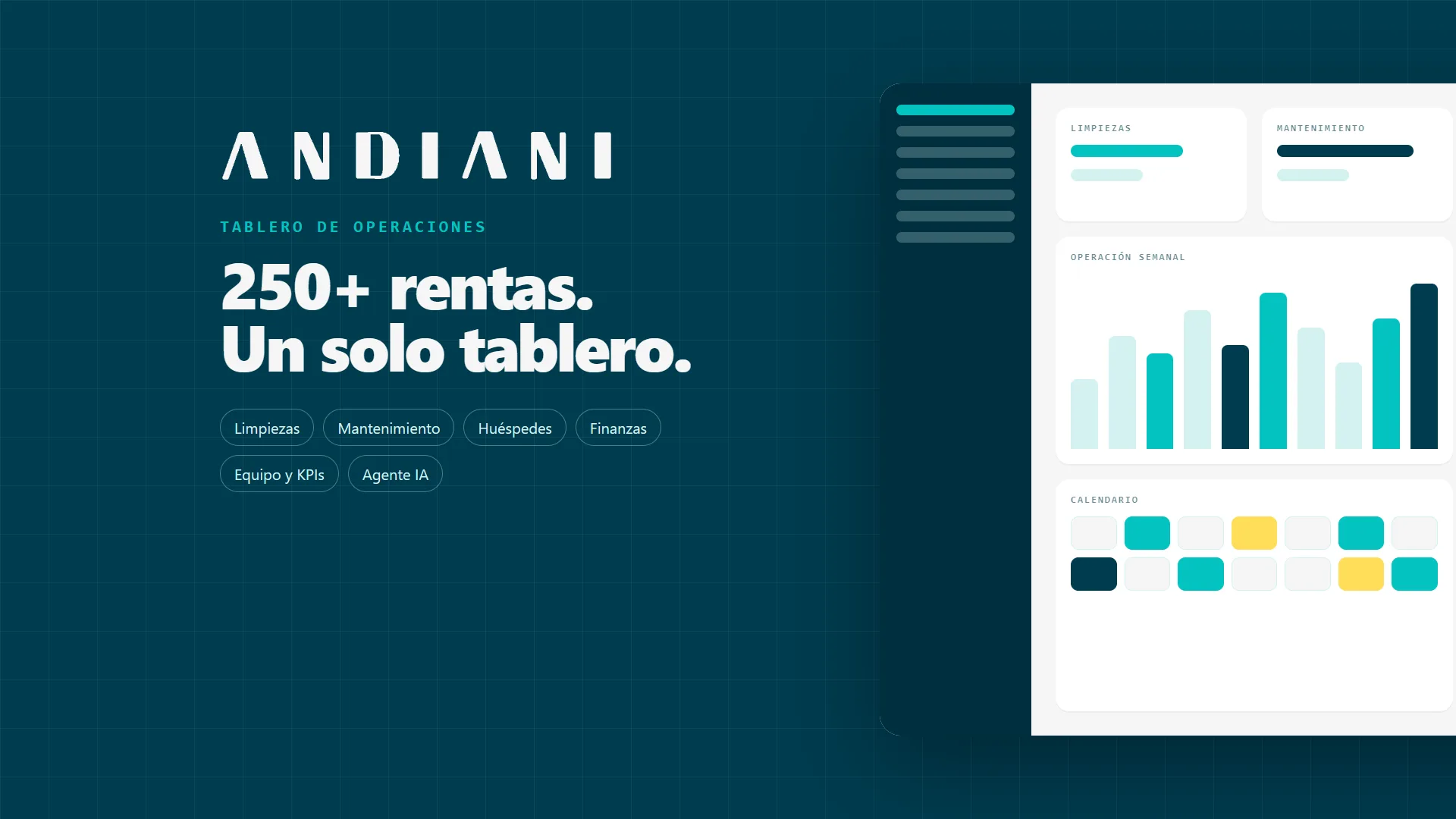
Andiani manages about 260 vacation rentals across Mexico. Its daily operation (cleaning, maintenance, guest messages, finance and team) lives in a real-time internal platform.
When I joined in July 2026, the platform was already in production, but it had been built entirely with AI-assisted generation and no architecture review: 160+ collections and 150+ server functions. As lead developer, my job was to make it secure, efficient and maintainable without stopping the operation.
Since it’s an internal tool, the images in this case study are illustrative and show no real data.
The Challenge
- Auditing in production: understand a large system nobody had reviewed and decide what to fix first, without disrupting the team that uses it every day.
- Security: access rules were far too permissive.
- Cost and performance: database consumption kept growing unchecked.
- Maintainability: a monolithic backend, with no CI/CD or monitoring.
The Solution
- Audit and prioritization: documented the technical debt and prioritized the critical findings: permissive security rules, a monolithic backend and no CI/CD or monitoring.
- Server-side security: a four-level cascading authorization model, materialized in a permissions mirror written only by the server, validated by declarative rules and covered by automated tests against the emulator.
- Database −75%: traced consumption down to its root cause (fan-out listeners, unwindowed queries and N+1 amplifiers in functions) and cut it 75% with precomputed aggregates and redesigned queries.
- Domain backend and CI/CD: modularized the backend by domain, set up CI/CD in GitHub Actions for the frontend, backend and auxiliary processes, and documented architecture decisions versioned alongside the code.
Beyond the dashboard
As System Specialist I also run the company’s PMS (Guesty) and its integrations. I implemented the team’s VoIP telephony with Twilio SIP and Poly phones, with call routing managed from the platform itself, and an AI guest-support agent that classifies messages, escalates to a human and runs in suggestion mode before automating.
Result
- A production platform the team uses every day, now with permissions enforced on the server and covered by automated tests.
- 75% less database consumption.
- A modular backend with CI/CD and documented architecture decisions, ready to keep growing.